

Positioned at the narrow entrance to the Bay of Kotor, Herceg Novi is a town whose identity has been shaped by strategy, conflict, and cultural exchange. Unlike many Adriatic settlements that evolved gradually from Roman or ancient origins, Herceg Novi has a clearly documented founding date and a turbulent political history marked by frequent changes in rule.
From its creation as a medieval fortress in the late 14th century to its development as a modern coastal town, Herceg Novi passed through the hands of Bosnian rulers, Ottoman administrators, Venetian governors, and Austro-Hungarian officials. Each period left lasting traces on the town’s architecture, urban form, and cultural character, shaping the different areas and neighbourhoods of Herceg Novi that visitors encounter today.
This guide presents a complete and historically accurate overview of Herceg Novi, with verified dates, clearly defined periods, and contextual explanations designed to help visitors understand how the past continues to shape the town today.
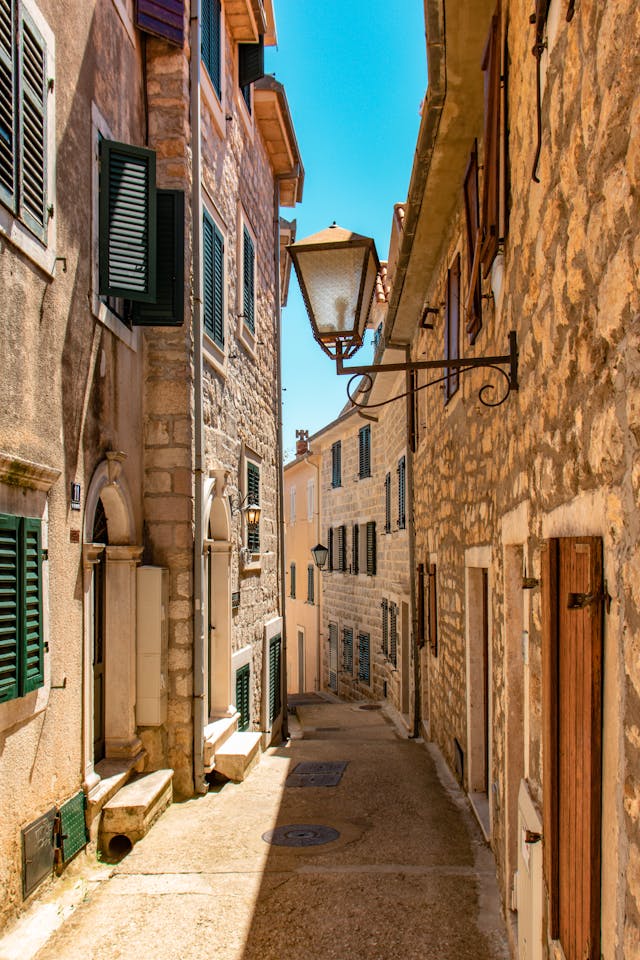
The Founding of Herceg Novi (1382)
Herceg Novi was founded in 1382 by King Tvrtko I of Bosnia, one of the most influential rulers in the medieval Balkans. At the time, Bosnia lacked secure access to the Adriatic Sea and depended heavily on the Republic of Dubrovnik for maritime trade. Tvrtko I sought to change this by establishing a fortified coastal settlement under Bosnian control, strengthening economic independence and political influence along the coast.
The newly founded settlement was originally named Sveti Stefan (Saint Stephen), a common medieval dedication that should not be confused with the later resort island near Budva. Its location was deliberately chosen at the entrance to the Bay of Kotor, allowing control over maritime traffic entering one of the Adriatic’s protected natural harbours. From the outset, the town was conceived primarily as a strategic military and political stronghold, rather than a commercial port.
The founding occurred during a period of intense regional rivalry. Tvrtko I had been crowned King in 1377, and the establishment of a coastal fortress reflected his broader ambition to assert Bosnian power among the Adriatic states. Although the settlement never developed into a major trading centre during his lifetime, its strategic value was immediately recognised by neighbouring powers, foreshadowing future struggles for control.
Early fortifications were constructed on steep terrain above the shoreline, forming the nucleus of what would later become the Old Town. These initial defences were modest but effective, reflecting the realities of late medieval warfare and the town’s position in a region frequently affected by shifting alliances and conflict.
The Origin of the Name “Herceg Novi”
The name Herceg Novi emerged in the mid-15th century during the rule of Stjepan Vukčić Kosača, a powerful regional nobleman. Kosača adopted the title “Herceg” (Duke), derived from the German Herzog, and asserted control over much of the surrounding territory.
Under his authority, the town became known as Herceg Novi, meaning “the Duke’s New Town.” The name reflected both its recent foundation and its association with ducal power. This period represented a brief phase of semi-independent rule before the town was drawn into the expansion of the Ottoman Empire.
Ottoman Rule (1482–1687)
In 1482, Herceg Novi was captured by the Ottoman Empire, beginning more than two centuries of Ottoman administration that would profoundly shape the town’s defensive layout and urban character. The conquest formed part of a wider Ottoman strategy to secure key points along the eastern Adriatic coast and to challenge Venetian naval dominance in the Bay of Kotor.
Military and Urban Transformation
Under Ottoman rule, Herceg Novi functioned primarily as a frontline fortress town, positioned at the western entrance to the bay. Existing medieval walls surrounding the Old Town were reinforced, and new defensive elements were added to accommodate artillery warfare, which had become central to coastal defence by the late 15th and 16th centuries. The settlement was reorganised to support a permanent military garrison, with urban space prioritised for defence, administration, and supply rather than civilian expansion.
The most prominent surviving structure from this period is Kanli Kula Fortress, constructed in the 16th century on elevated ground overlooking the town. Many of these fortifications remain accessible today and form a central part of things to do in Herceg Novi, allowing visitors to experience the town’s defensive past firsthand. Originally designed as part of the wider defensive system protecting landward approaches, Kanli Kula later served as a prison, giving rise to its name, which translates as “Bloody Tower.” Its imposing position reflects the Ottoman emphasis on internal security as well as external defence.
Ottoman urban infrastructure extended beyond fortifications. Water cisterns were constructed to ensure reliable supply during sieges, while military barracks and administrative buildings supported the town’s role as a regional stronghold. Although few of these civilian or service structures survive intact today, their placement influenced the layout of streets, neighbourhoods, and open spaces within and around the fortified core.
By the end of the Ottoman period in 1687, Herceg Novi had been firmly established as a military outpost rather than a commercial centre. The defensive framework created during these two centuries shaped the town’s physical form long after Ottoman rule ended, influencing later Venetian and Austro-Hungarian adaptations and leaving a lasting imprint on the urban landscape still visible today.
Religious and Social Life
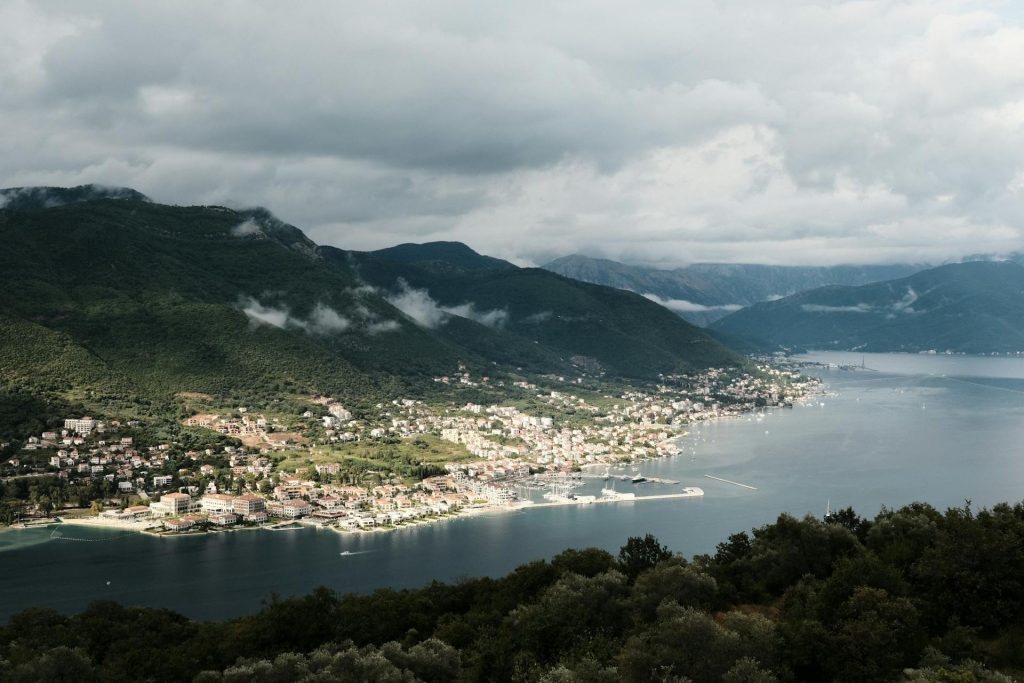
During the period of Ottoman rule (1482–1687), Herceg Novi was characterised by a structured form of religious diversity typical of frontier towns within the empire. Islam became the administrative and military religion, reflected in the presence of Ottoman officials, garrison forces, and religious institutions. At the same time, Orthodox Christian and Catholic communities continued to practice their faith under the millet system, which granted a degree of religious autonomy in exchange for loyalty to the state and the payment of taxes.
Ottoman Herceg Novi contained mosques, public baths (hamams), fountains, and other civic structures that supported daily life within a fortified military town. Although most of these buildings were altered, repurposed, or removed during later Venetian and Austro-Hungarian rule, their former presence influenced the organisation of streets, neighbourhoods, and public spaces. The construction of Kanli Kula Fortress in the 16th century, along with other defensive works, reinforced the town’s identity as a strategic stronghold rather than a civilian centre. Even where physical structures no longer survive, Ottoman rule left a lasting imprint on the town’s spatial layout and defensive character.
Economy and Daily Life
Economic activity in Ottoman-era Herceg Novi remained limited and closely tied to its military function. Unlike major Adriatic ports such as Dubrovnik or Kotor, the town did not develop into a commercial hub. Its economy was shaped primarily by the needs of the garrison and the realities of life within fortified walls.
Daily economic life revolved around supplying military personnel, coastal fishing, and small-scale craftsmanship that supported local needs. Artisans produced basic goods, while fishermen relied on the sheltered waters of the bay for sustenance rather than large-scale trade. Agricultural activity was minimal within the town itself due to limited space, with surrounding rural areas providing food supplies.
Population growth was constrained by both the town’s defensive layout and its strategic role. Housing remained concentrated within fortified areas, and civilian expansion was secondary to military priorities. This combination of limited economic opportunity and spatial restriction ensured that Herceg Novi remained relatively small throughout the Ottoman period, preserving its character as a fortified outpost rather than a bustling port city.
Venetian Rule (1687–1797)
Herceg Novi came under Venetian control in 1687, during the Morean War between Venice and the Ottoman Empire. This marked a major cultural and architectural transition.
Integration into the Venetian Adriatic
The town became part of the Venetian administrative region known as Venetian Albania. Venetian authorities focused on strengthening coastal defences and securing maritime routes. Herceg Novi was incorporated into a wider network of Adriatic fortresses designed to protect Venetian trade.
Forte Mare Fortress, originally medieval in origin, was expanded and adapted to support cannon warfare. Venetian military engineers modernised walls and bastions to meet the demands of early modern artillery.
Cultural and Architectural Influence
Following the Venetian capture of Herceg Novi in 1687, the town underwent a clear cultural and architectural transformation as it was incorporated into the administrative system of the Republic of Venice. Venetian authorities strengthened Catholic institutions as part of their broader religious and political policy along the Adriatic frontier. Churches such as Church of St. Jerome, built or remodelled during the Venetian period, reflect this renewed Catholic presence alongside the long-established Orthodox community.
Venetian rule also introduced durable stone civic architecture intended to project stability and order rather than purely military strength. Administrative and residential buildings constructed or adapted in the late 17th and 18th centuries followed Venetian architectural conventions, favouring cut stone façades, symmetrical layouts, and practical design. These influences are particularly visible around the Old Town’s main squares and near key defensive structures such as Forte Mare Fortress, which was expanded and modernised under Venetian engineers to accommodate artillery and protect the harbour.
Elements of Venetian urban planning were gradually introduced within the constraints of the fortified town. Improved internal circulation connected religious, civic, and military spaces more efficiently, reinforcing Herceg Novi’s role within Venice’s Adriatic defensive network. Decorative and symbolic features from this period remain embedded in the Old Town fabric, including Latin inscriptions, carved coats of arms, and reliefs bearing the Lion of Saint Mark, the emblem of Venetian authority, still visible on walls and gateways today.
Although Venetian rule ended in 1797 with the collapse of the republic, its influence proved remarkably durable. Civilian life expanded during this period as military priorities slowly gave way to commerce and administration. Local artisans, sailors, and merchants became increasingly connected to Venetian maritime networks, even though Herceg Novi never rivalled Venice or Dubrovnik as a major trading port. This era marked a lasting shift from a purely defensive stronghold to a more complex coastal town shaped by both military and civilian life.
Austro-Hungarian Administration and the 19th Century (1797–1918)
The fall of the Republic of Venice in 1797 brought an end to centuries of Venetian influence and ushered in a period of political uncertainty for Herceg Novi. After brief administrative changes in the early 19th century, the town became part of the Austro-Hungarian Empire, marking a decisive shift from a frontier fortress to a civilian coastal settlement.
Modernisation, Infrastructure, and the Rise of Early Tourism
Under Austro-Hungarian administration from the mid-19th century onward (formally from 1815, consolidated after 1849), Herceg Novi underwent its first sustained programme of civilian modernisation. Imperial priorities of connectivity, public order, and public health reshaped the town’s physical fabric and gradually transformed it from a frontier stronghold into a liveable coastal settlement.
By the 1860s and 1870s, new road connections were developed along the coast, linking Herceg Novi more efficiently with settlements such as Meljine, Zelenika, and Kumbor, and integrating the town into the wider Austro-Hungarian transport network of the Bay of Kotor. These improvements reduced long-standing isolation and made seasonal travel more practical, both for administrators and for early visitors. At the same time, harbour facilities near the Old Town and Meljine were upgraded to support civilian maritime traffic alongside naval use, reinforcing Herceg Novi’s role as a coastal stop rather than a purely defensive port.
Public administration buildings and civic infrastructure were introduced in the late 19th century, bringing modern bureaucratic governance, postal services, and basic utilities. Investments in sanitation and water supply reflected contemporary Austro-Hungarian public health policy, which increasingly linked clean air, mild climate, and hygiene to medical recovery. These reforms had a direct impact on daily life and improved living standards across the town.
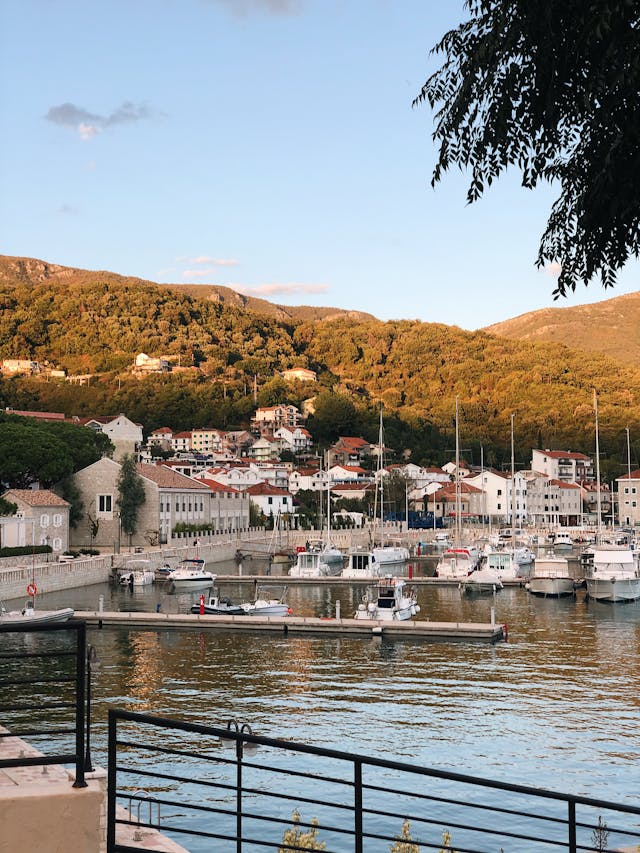
By the 1880s and 1890s, these changes began to attract visitors drawn by Herceg Novi’s sheltered position, Mediterranean vegetation, and winter climate. This early tourism trend laid the groundwork for later coastal leisure development and shaped the town’s modern beaches in Herceg Novi. The neighbouring area of Igalo became particularly significant after the scientific recognition of its healing mud and mineral waters at the turn of the 20th century. This laid the foundations for organised health tourism, which would expand rapidly in the early decades of the 20th century.
In this way, modernisation and early tourism in Herceg Novi developed together. Austro-Hungarian infrastructure projects did not merely improve administration and transport; they directly enabled the town’s transition toward a health-oriented and civilian coastal destination, setting the stage for its later prominence in Yugoslav-era tourism.
These developments gradually shifted Herceg Novi away from its exclusive military role and encouraged civilian expansion beyond the old defensive walls.
Early Tourism and Health Culture
By the late 19th century, the town’s mild Mediterranean climate and sheltered coastal position began attracting visitors seeking rest and recovery. This early form of seasonal tourism laid the foundations for the later development of health and spa culture, particularly in nearby Igalo, which would emerge in the 20th century as a major medical and wellness destination.
The 20th Century: War, Yugoslavia, and Tourism
After World War I (1918), Herceg Novi became part of the Kingdom of Yugoslavia, marking its transition into a new South Slavic state. The town’s strategic coastal position again made it vulnerable during World War II (1941–1945), when it experienced occupation, disruption of civilian life, and economic hardship. The post-war period brought profound political and social change, reshaping both governance and daily life.
Socialist Yugoslavia (1945–1992)
Following the establishment of socialist Yugoslavia in 1945, Herceg Novi entered a period of rapid transformation driven by state-led development and central economic planning. Tourism was identified early as a strategic sector for the Adriatic coast, and Herceg Novi’s sheltered position, mild climate, and existing infrastructure made it a natural focus for investment.
From the 1950s through the 1970s, large-scale hotel construction expanded accommodation capacity along the coastline, particularly in areas such as Topla, Igalo, and Meljine. These developments marked Herceg Novi’s emergence as a modern Adriatic resort, capable of hosting domestic and international visitors within the socialist tourism model.
At the same time, the seaside promenade—later formalised as part of the town’s coastal pedestrian network—was expanded to improve public access to the sea and strengthen the connection between residential neighbourhoods and the waterfront. This transformation reshaped everyday life, turning the coastline into a shared civic space rather than a purely utilitarian or defensive zone.
A defining feature of this period was the formal development of Igalo as a medical and rehabilitation centre. Building on earlier recognition of its mineral-rich mud and favourable climate, Igalo developed into one of the leading health tourism destinations in the former Yugoslavia, particularly from the 1960s onward, attracting patients and visitors from across Eastern and Central Europe.
While socialist-era development significantly altered parts of the coastline, the historic Old Town remained largely intact. Its steep terrain, dense medieval layout, and limited accessibility made large-scale construction impractical, inadvertently preserving much of Herceg Novi’s historic character even as modern tourism infrastructure expanded around it.
Herceg Novi in Modern Montenegro (2006–Present)
Following Montenegro’s independence in 2006, Herceg Novi entered a new phase focused on heritage preservation and sustainable tourism. Restoration projects have stabilised fortresses, monasteries, and historic streets, ensuring that the town’s layered past remains accessible to visitors.
Tourism today balances cultural exploration with seaside leisure, reflecting both the town’s historical depth and its modern role as a coastal destination.
Key Historical Sites Still Visible Today
Herceg Novi’s history can be experienced directly through its landmarks, many of which date back to the town’s most important historical periods. These sites reflect the strategic, religious, and defensive roles the town played under successive rulers and remain central to understanding its development.
-
Forte Mare Fortress – Medieval in origin and later expanded under Venetian rule, this coastal fortress was built to defend the harbour and control maritime access to the town. Its position above the shoreline highlights Herceg Novi’s long-standing relationship with the sea.
-
Kanli Kula Fortress – A 16th-century Ottoman fortification constructed during the period of Ottoman rule, later used as a prison. The fortress reflects the military and administrative priorities of the Ottoman Empire in this strategically important coastal town.
-
Španjola Fortress – Built during Ottoman rule in the 16th century and positioned high above the town, Španjola Fortress illustrates the importance of monitoring land approaches to the Bay of Kotor as well as maritime routes.
-
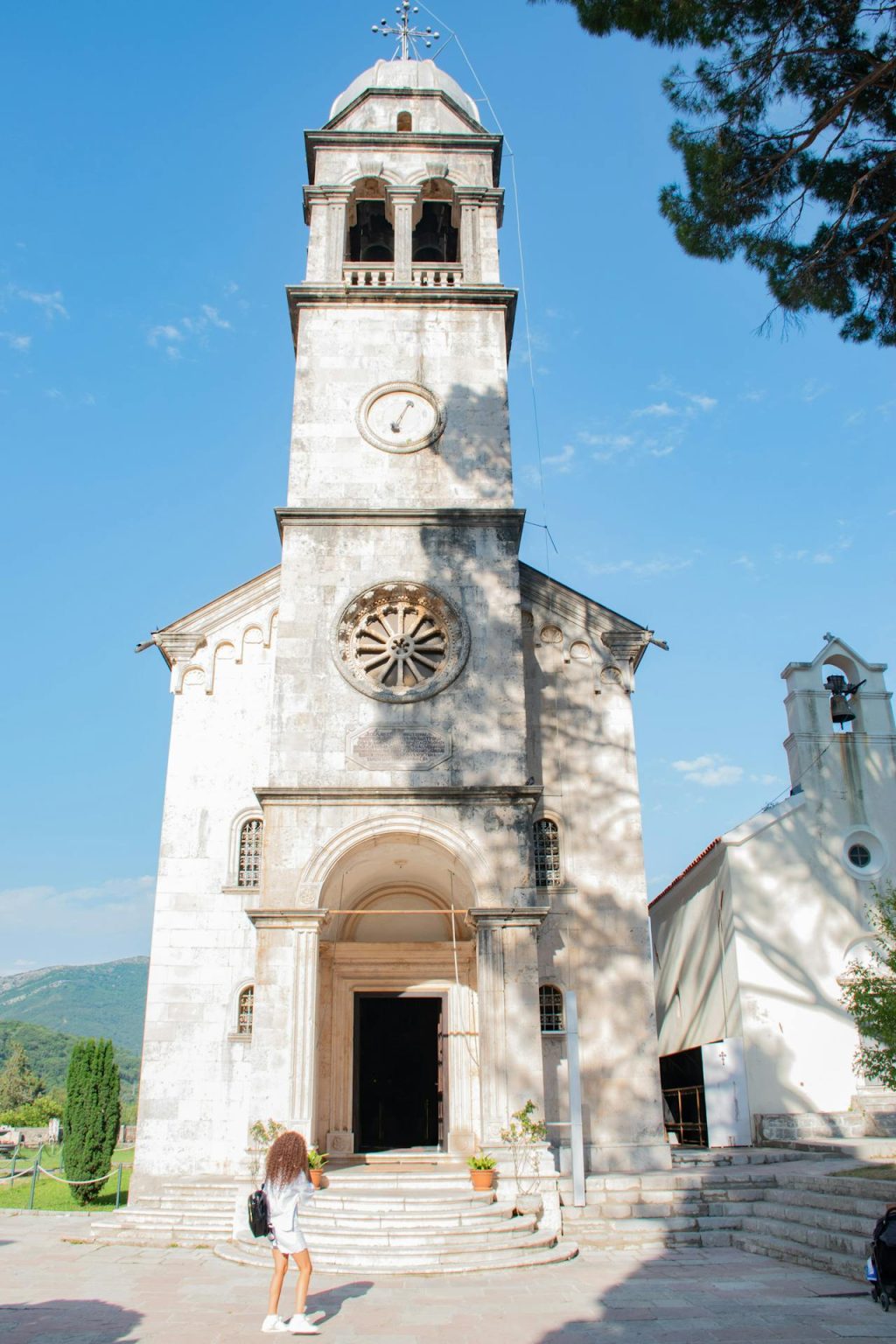
Savina Monastery – An important Orthodox monastic complex whose origins date back several centuries, representing religious continuity and cultural life throughout periods of political change.
Together, these sites form a physical record of Herceg Novi’s complex and layered past, allowing visitors to experience history directly through the town’s architecture and landscape.
Why Herceg Novi’s History Is Unique on the Adriatic
Unlike many Adriatic coastal towns that developed steadily under a single dominant empire, Herceg Novi experienced frequent and often abrupt changes in rule over a relatively short historical period. Founded in the late medieval era rather than antiquity, the town was shaped successively by Bosnian rulers, Ottoman administrators, Venetian governors, and Austro-Hungarian officials, each leaving distinct architectural, cultural, and administrative marks.
Rather than replacing what came before, these powers layered new functions onto the existing town. Ottoman military planning reinforced medieval defences, Venetian rule introduced maritime fortifications and Catholic institutions, and Austro-Hungarian administration brought modern infrastructure and early tourism. As a result, Herceg Novi developed without the classical Roman urban grid typical of older Adriatic towns, giving it a more vertical, fortress-oriented character.
This overlapping of influences created a town where Eastern and Western traditions coexist within a compact space, making Herceg Novi historically richer and more complex than many of its coastal neighbours.
Conclusion: A Living Historical Landscape
Herceg Novi’s history is not confined to archives, inscriptions, or museum collections. It is visible in the town’s fortresses overlooking the sea, in stairways shaped by centuries of daily movement, in monasteries that survived political upheaval, and in neighbourhoods formed around defence rather than trade. The town’s physical landscape reflects its long role as a strategic stronghold at the entrance to the Bay of Kotor.
Understanding this layered past allows visitors to appreciate Herceg Novi not only as a seaside destination, but as a place shaped by resilience, adaptation, and cultural exchange. Walking through the town today is, in many ways, an encounter with living history — one that continues to define Herceg Novi’s identity in the modern Adriatic world.
